

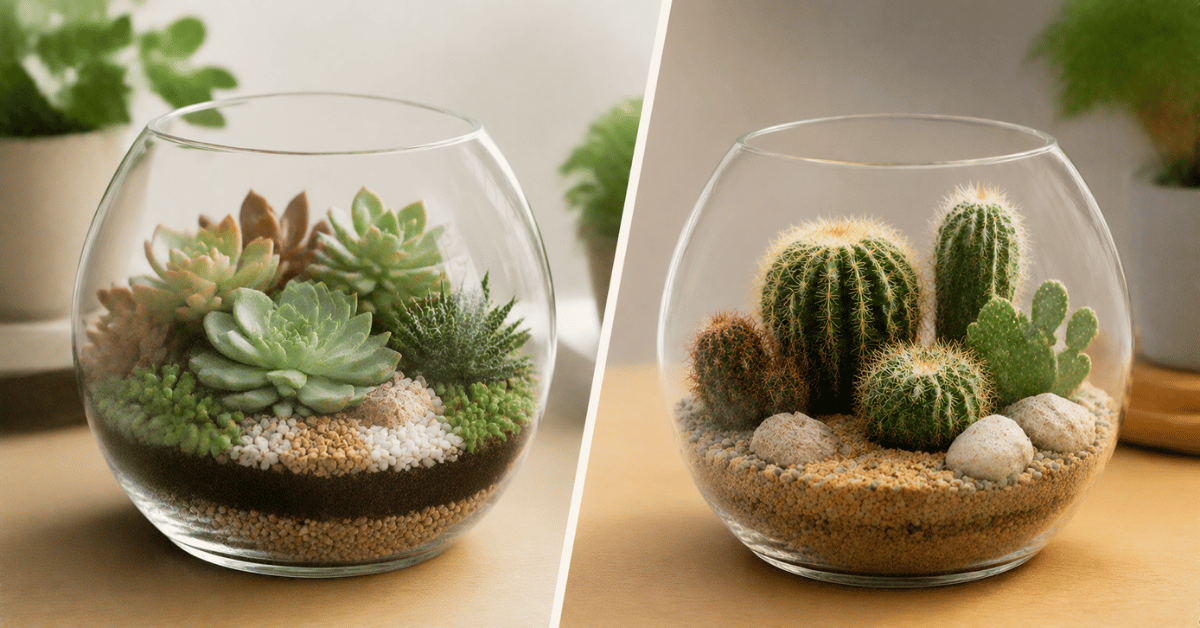
Succulent vs Cactus Terrariums: What’s the Difference?
Succulent and cactus terrariums are often treated as the same thing. After all, both are associated with drought-tolerant plants, gritty soil, decorative stones, and miniature desert landscapes. But that similarity can lead to one of the most common terrarium mistakes: choosing plants for their appearance rather than for the conditions they actually need.
The distinction matters because a terrarium changes how quickly water evaporates, how much air reaches the roots, and how humid the immediate environment becomes. Those factors are especially important in Singapore, where the climate is naturally warm and humid. Typical cacti and many popular succulents prefer excellent drainage, good ventilation, and relatively dry conditions rather than the moisture-retaining environment of a traditional closed terrarium.
There is also a botanical point worth clearing up from the start: all cacti are succulents, but not all succulents are cacti. A cactus belongs specifically to the Cactaceae family, while “succulent” is a broader description for plants that store water in fleshy leaves, stems, or roots.
Understanding that difference makes it much easier to create a terrarium that still looks attractive months after it leaves the workshop table.
Why Succulent and Cactus Terrariums Are Not Interchangeable
The biggest difference between a succulent terrarium and a cactus terrarium is not the glass container or decorative sand. It is the range of plants inside and, consequently, the care those plants require.
A succulent terrarium can contain plants from many botanical groups. A cactus terrarium is narrower: its main plants belong to the Cactaceae family. Because different succulents can have noticeably different light and watering requirements, a succulent arrangement may actually require more thought when plants are being combined. University of Minnesota Extension specifically recommends grouping cacti and succulents according to compatible water requirements and growth rates rather than simply placing attractive plants together.
CraftLabs’ Succulent Terrarium Workshop in Singapore, for example, offers both cacti and non-cactus succulents and lists plants such as jade plants, Kalanchoe tomentosa, Sedum, Echeveria, Haworthia, Aloe, and others. Participants work with a glass container, growing medium, stones, gravel, and decorative elements, illustrating just how varied a “succulent terrarium” can be.
What Counts as a Succulent?
“Succulent” describes plants with thickened tissues adapted for storing water. That stored moisture may be concentrated in leaves, stems, roots, or a combination of these structures. This is why succulents can look dramatically different from one another.
An Echeveria may form a compact rosette of fleshy leaves. Jade plants develop thicker leaves and branching stems. Sedums range from compact clusters to trailing forms. Haworthias can remain relatively small and are often better suited to less intense light than sun-loving desert species.
That diversity is one of the greatest advantages of a succulent terrarium: you have more freedom to create differences in height, leaf shape, texture, and form. The trade-off is that not every succulent should automatically share the same container. Successful dish gardens depend on combining plants with similar light and moisture requirements.
What Makes a Cactus Different?
Cacti are specialized succulents belonging to the Cactaceae family. Their most reliable identifying feature is not simply the presence of spines. It is the areole—a small specialized structure from which spines, flowers, branches, or new growth may develop. Areoles are unique to cacti, which makes them much more useful for identification than the general rule that “cacti are prickly.”
This matters because plenty of non-cactus succulents have sharp leaves or thorn-like structures, while some cacti appear relatively soft or almost spineless.
Most of the small desert cacti commonly used in decorative arrangements favor bright light, very free-draining soil, and substantial drying between waterings. However, there are exceptions. Rainforest cacti such as Schlumbergera and some epiphytic cacti naturally experience more humidity, filtered light, and more regular moisture than typical desert species.
So a plant’s actual species and habitat should ultimately guide its care—not the word “cactus” alone.
How the Terrarium Setup Changes
Whether you choose cacti or other succulents, the first design decision should be open versus closed.
A traditional closed terrarium traps humidity and recycles moisture through evaporation and condensation. That environment suits moisture-loving tropical plants such as Fittonia and small ferns. The Royal Horticultural Society and Penn State Extension both recommend keeping cacti and succulents in open terrariums or dish gardens rather than closed terrariums.
For a cactus or succulent arrangement, prioritize:
- A wide, open container. The opening allows moisture to escape and improves air exchange. RHS specifically recommends open terrariums for succulents.
- A fast-draining growing medium. Cacti and most succulents perform best in gritty, porous mixes that resist waterlogging.
- Plants with similar needs. A cactus that wants prolonged dry periods should not be planted beside a succulent that needs noticeably more frequent moisture.
- Enough space for airflow and growth. Packing plants tightly may look impressive on day one but makes maintenance more difficult as plants expand.
Care Needs in Singapore’s Warm, Humid Climate
Singapore changes the equation slightly compared with growing cacti in a dry, temperate home.
Meteorological Service Singapore describes the country’s climate as warm, humid, and rainy, while most common desert cacti and many succulents prefer relatively low atmospheric humidity, good ventilation, and free-draining conditions.
That makes moisture management more important than following a fixed watering schedule.
A practical Singapore care routine is:
- Check the growing medium before watering. University of Minnesota Extension advises allowing the soil of typical cacti and succulents to dry completely between waterings.
- Keep the terrarium open. Closing the lid traps the very humidity these plants generally do not need.
- Prioritize airflow. RHS notes that cacti and succulents generally benefit from ventilation, which also helps reduce conditions favorable to fungal problems.
- Provide strong light without making sudden changes. Many cacti and succulents need bright conditions, but plants moved abruptly from lower light into intense direct sun can scorch. Gradual acclimatization is safer.
- Keep outdoor arrangements protected from heavy rain. A glass container without drainage can become waterlogged quickly if rain enters it; waterlogged growing media are strongly associated with root and stem rot in cacti and succulents.

Choosing the Right Terrarium for Your Space or Workshop

For most people, the decision comes down to the look they want and the growing conditions they can provide.
A succulent terrarium is usually the better choice when visual variety matters. Rosettes, upright plants, trailing varieties, and contrasting leaf textures can create a layered miniature landscape. The broader plant selection also makes succulent terrariums well suited to creative workshops where participants want noticeably different finished designs. CraftLabs, for example, combines succulent or cactus choices with colored stones, sand, gravel, figurines, and other decorative elements.
A cactus terrarium works particularly well when you prefer a stronger desert aesthetic: rounded forms, columns, ribs, spines, and larger areas of visible stone or sand. Typical desert cacti can also tolerate prolonged drying, although they still require sufficient light and should never be treated as plants that need no care at all.
A mixed cactus-and-succulent terrarium can work, but compatibility comes first. University of Minnesota Extension cautions that most cacti need less water than many other succulents, which means attractive mixed arrangements can become difficult to manage when their requirements diverge.
For workshops and team-building activities, that distinction has a practical benefit: selecting compatible plants and explaining their care clearly increases the chances that participants take home an arrangement they can realistically maintain. CraftLabs’ workshop already reflects this hands-on approach by combining plant selection, layering, planting, decoration, and aftercare guidance in the activity.
Want to learn these terrarium-making techniques hands-on? CraftLabs workshops provide a practical experience where participants learn about plant selection, terrarium setup, layering, decoration, and proper aftercare to create beautiful and long-lasting arrangements. Join a CraftLabs workshop to explore the art of succulent and cactus terrariums with expert guidance. For workshop details and bookings, visit www.craftlabs.sg or contact CraftLabs for more information.
Conclusion
The difference between succulent and cactus terrariums goes far beyond whether the plants have spines.
Cacti are one specialized group within the much broader world of succulents. Both can make striking miniature landscapes, but their success depends on open containers, compatible plant combinations, fast-draining growing media, sufficient light, restrained watering, and good airflow.
Those principles become particularly important in Singapore’s warm, humid environment. Instead of trying to recreate a sealed miniature ecosystem, think of a cactus or succulent terrarium as a carefully designed open container garden.
That shift in mindset is the key to creating something that is not merely attractive on the day it is assembled, but healthy and enjoyable long afterward.
FAQs
Can cacti and succulents grow together in the same terrarium?
Yes, provided the chosen plants have similar light and watering requirements. Some cacti need longer dry periods than other succulents, so compatibility should be checked before combining them.
Should a cactus terrarium be open or closed?
Open. Typical desert cacti prefer lower humidity and better airflow, while closed terrariums retain moisture and are more appropriate for humidity-loving tropical plants.
How often should I water a succulent terrarium in Singapore?
Avoid watering by a fixed weekly schedule. Check the growing medium and allow it to dry thoroughly between waterings for typical drought-adapted succulents and cacti. Water especially cautiously when the glass container has no drainage hole.
Which is easier to maintain: a cactus or succulent terrarium?
Both can be low-maintenance when correctly planted. Cacti generally tolerate long dry periods, while succulent terrariums offer more plant choices but require closer attention to compatibility between species.
Does a succulent terrarium need a drainage layer?
A layer of gravel is not a replacement for a drainage hole. In a glass container without drainage, use a very free-draining growing medium and control watering carefully so excess water does not accumulate around the roots.
