

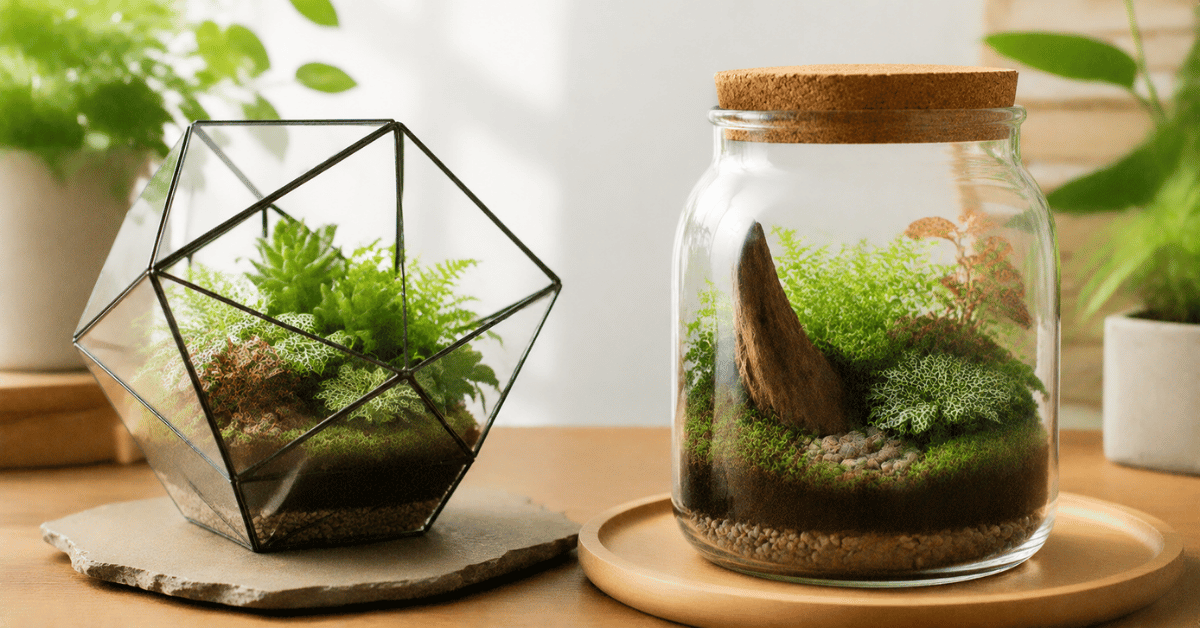
Open vs Closed Terrariums: Which Is Best in Singapore?
Choosing between an open and closed terrarium sounds simple until you factor in Singapore’s climate. A glass container that thrives in a dry, temperate home may behave very differently in a warm, humid apartment here. The wrong combination of container, plants, moisture and light can quickly lead to rotting roots, mould, stretched growth or a terrarium that needs far more maintenance than expected.
The key difference is not simply whether a terrarium has a lid. Open and closed terrariums create fundamentally different growing environments. Closed containers retain moisture and create a humid miniature ecosystem, while open designs allow moisture and heat to escape more freely. The Royal Horticultural Society recommends closed terrariums for small tropical plants that enjoy humidity and open terrariums for plants such as succulents that prefer less humid conditions.
In Singapore, neither design is automatically better. The right choice depends on the plants you want to grow, where the terrarium will sit and how involved you want to be in maintaining it.
Why Singapore’s Climate Changes the Terrarium Equation
Singapore already provides a warm, humid environment. NParks notes that outdoor relative humidity averages around 80%, while the Meteorological Service Singapore describes the country as having consistently high humidity and warm conditions. That matters because a terrarium modifies the environment around a plant rather than simply decorating it.
A closed terrarium adds another moisture-retaining layer to an already humid climate. Water evaporates from the substrate and plants, condenses against the cooler glass and returns to the growing medium. Because relatively little moisture escapes, established closed terrariums can go long periods without additional watering. The RHS notes that sealed terrariums generally need watering only a few times a year when their moisture level is properly balanced.
That sounds ideal for busy Singapore households, but there is a catch: low maintenance is not the same as no maintenance. Excess water in a closed container has nowhere to go. Persistent saturation, decaying foliage and poor airflow can create conditions where mold becomes a problem, so dead plant material should be removed and excessive condensation should be addressed rather than ignored.
Open terrariums behave differently. Moisture can escape from the top, making them easier to keep comparatively dry. However, they must be watered more regularly. Craft Labs’ own care guidance reflects this distinction: its closed terrariums require much less frequent watering than its open designs, where evaporation happens considerably faster.
The practical lesson for Singapore is straightforward: choose your terrarium according to the microclimate the plants require, not according to the country’s weather alone.
How Open and Closed Terrariums Actually Behave
Closed Terrariums Create a Humid Miniature Ecosystem
A closed terrarium uses a lid or narrow opening to restrict the exchange of moisture with the surrounding room. Humidity remains high while water continually moves between the soil, plants, air and glass surfaces. This makes closed terrariums especially well suited to compact tropical foliage plants, mosses and small ferns.
Fittonia is a classic example. It prefers warm, humid conditions and is particularly well suited to terrarium growing. Small peperomias, Hypoestes, Pilea, Selaginella and miniature ferns can also work well when their mature size suits the container.
Singapore growers have some excellent humidity-loving options. NParks, for instance, recommends the small fern Bolbitis heteroclita Difformis Group for very humid environments such as terrariums and advises indirect light rather than harsh sun.
Closed terrariums therefore make sense when you want a lush, woodland-style display with foliage, moss, stones and miniature landscape features. Once its moisture balance settles, a well-planted container can also be convenient for an office desk or home where frequent watering would be inconvenient.
Open Terrariums Offer Better Airflow and Moisture Control
An open terrarium leaves a large part of the container exposed to the room. It therefore behaves more like a decorative indoor planter than a sealed ecosystem. Water evaporates more readily, humidity does not remain as consistently high and you retain greater control over when the growing medium becomes wet or dry.
This design is particularly useful for succulents because their fleshy leaves and stems are adapted to store water. The RHS specifically recommends succulents for open rather than sealed terrariums.
That distinction becomes especially important in humid Singapore. Not every exotic-looking plant wants tropical terrarium humidity. NParks gives a striking local example with the pygmy sundew Drosera × carbarup: humidity of 80% or more can harm it, and NParks recommends growing it indoors in an air-conditioned environment because outdoor Singapore conditions are too humid.
An open terrarium is consequently the safer choice whenever your plant selection requires faster drying, stronger airflow or tighter control over moisture.

So, Which Terrarium Is Best for Singapore?

There is no universal winner, but a closed terrarium is usually the better choice for people seeking the classic lush tropical terrarium experience, while an open terrarium is preferable for plants that dislike continuously humid conditions.
| Consideration | Closed Terrarium | Open Terrarium |
| Best plant style | Mosses, miniature ferns, Fittonia and humidity-loving foliage | Succulents and other plants that prefer lower humidity |
| Water retention | Very high; moisture is recycled inside the container | Lower; water evaporates into the room |
| Watering frequency | Generally infrequent once balanced | More frequent than a closed system |
| Airflow | Limited | Much greater |
| Main risk in Singapore | Too much moisture or persistent condensation | Overwatering plants that prefer dry conditions |
| Best for beginners? | Excellent when suitable plants and moisture levels are chosen | Good for people comfortable monitoring soil dryness |
For a first terrarium in Singapore, plant choice should come before container choice.
Think of it this way: someone wanting a miniature rainforest for an office desk should start with a closed design and humidity-loving foliage. Someone attracted to architectural succulents and a rocky desert-style landscape should choose an open design instead.
There is also a lifestyle consideration. A properly balanced closed terrarium can suit people who travel regularly or do not want to water plants every few days. An open terrarium provides more direct control, which can appeal to plant owners who enjoy monitoring and tending their arrangement regularly. Closed terrariums still need observation, however; they should not simply be sealed and forgotten indefinitely.
Choosing Plants and Avoiding Common Singapore Terrarium Mistakes
The most attractive plants are not always the most compatible plants. A successful terrarium should group species with similar requirements for humidity, moisture and light. Mixing a moisture-loving fern with a succulent, for example, creates an unavoidable conflict: keeping one plant comfortable may leave the other too wet or too dry. The RHS therefore separates humid tropical species for closed containers from succulents suited to open terrariums.
It is also worth considering mature size. Plants that look perfectly miniature when purchased can eventually become too vigorous for the container. Slow-growing, compact foliage plants are easier to maintain in enclosed environments.
For Singapore homes and offices, keep these practical rules in mind:
- Keep closed terrariums away from strong direct sun. Glass traps heat, while common closed-terrarium plants generally perform best in bright, indirect light. The RHS recommends bright indirect light for terrariums, and NParks similarly recommends indirect light for humidity-loving Bolbitis.
- Do not water according to a rigid calendar alone. Check the substrate, plant condition and condensation first. Closed terrariums often require surprisingly little additional water.
- Remove damaged or decaying foliage early. Organic debris left in a humid enclosure can encourage mould.
- Do not assume indoor light is sufficient because the room looks bright. NParks explains that human eyes and plants perceive useful light differently. Where natural light is inadequate, suitable LED lighting can support ornamental indoor plants without producing as much heat as some alternatives.
- Match the container to the plant rather than forcing a favorite plant into the wrong environment. Humidity-loving tropical foliage belongs in enclosed designs; dry-loving plants need greater ventilation.
This is one reason a guided terrarium workshop in Singapore can be useful for first-time makers. Craft Labs’ terrarium sessions cover how a terrarium becomes self-sustaining, explain the purpose of the different materials and guide participants through building their own arrangement. Its current range includes both classic terrarium activities and air-plant terrarium workshops, with participants taking their finished creations home.
Understanding why each layer, plant and watering decision matters gives you a much better chance of keeping the finished terrarium healthy after the workshop rather than treating it as temporary décor.
The Best Terrarium Is the One That Matches Its Plants
For Singapore, the open-versus-closed question is ultimately less about declaring one design superior and more about building the right microclimate.
Choose a closed terrarium when you want mosses, miniature ferns, Fittonia and other compact tropical plants that enjoy stable humidity. It offers the familiar self-contained terrarium experience and can require remarkably little watering once properly balanced.
Choose an open terrarium when airflow and faster drying matter more, particularly for succulents or plants that would struggle in continuously humid enclosed conditions.
Singapore’s humid climate makes moisture management especially important, but it does not make closed terrariums unsuitable. In fact, tropical terrarium plants can be an excellent fit here when water, light and plant selection are properly balanced. The future of your miniature garden depends far more on matching the ecosystem to its inhabitants than on whether the glass jar happens to have a lid.
Want to learn how to create and maintain the right terrarium ecosystem? CraftLabs workshops offer a hands-on experience where participants learn about choosing suitable plants, building terrarium layers, balancing moisture levels, and designing beautiful indoor landscapes. These practical sessions help you understand the techniques behind creating healthy and long-lasting terrariums. To join a CraftLabs workshop or learn more, visit www.craftlabs.sg or contact CraftLabs for workshop details.
FAQs
Which terrarium is easiest to maintain in Singapore?
A properly balanced closed terrarium is generally easier in terms of watering because it recycles moisture internally. However, you still need to monitor condensation and remove decaying leaves.
Can succulents survive in a closed terrarium?
Closed terrariums are generally not recommended for succulents because they maintain high humidity. Succulents are better suited to open terrariums where moisture can escape.
Where should I place a terrarium in a Singapore home?
Choose a location with bright, indirect light and avoid strong direct sunlight. Artificial lighting can help in rooms where adequate natural light is unavailable.
Why is there condensation inside my closed terrarium?
Some condensation is part of the normal water cycle inside a closed terrarium. Persistent heavy condensation, however, can indicate excessive moisture and should prompt closer monitoring of the terrarium’s water balance.
What are good plants for a closed terrarium in Singapore?
Fittonia, small peperomias, Pilea, Hypoestes, miniature ferns and certain mosses are good candidates because they appreciate humid conditions and can remain compact when suitable varieties are chosen.
