

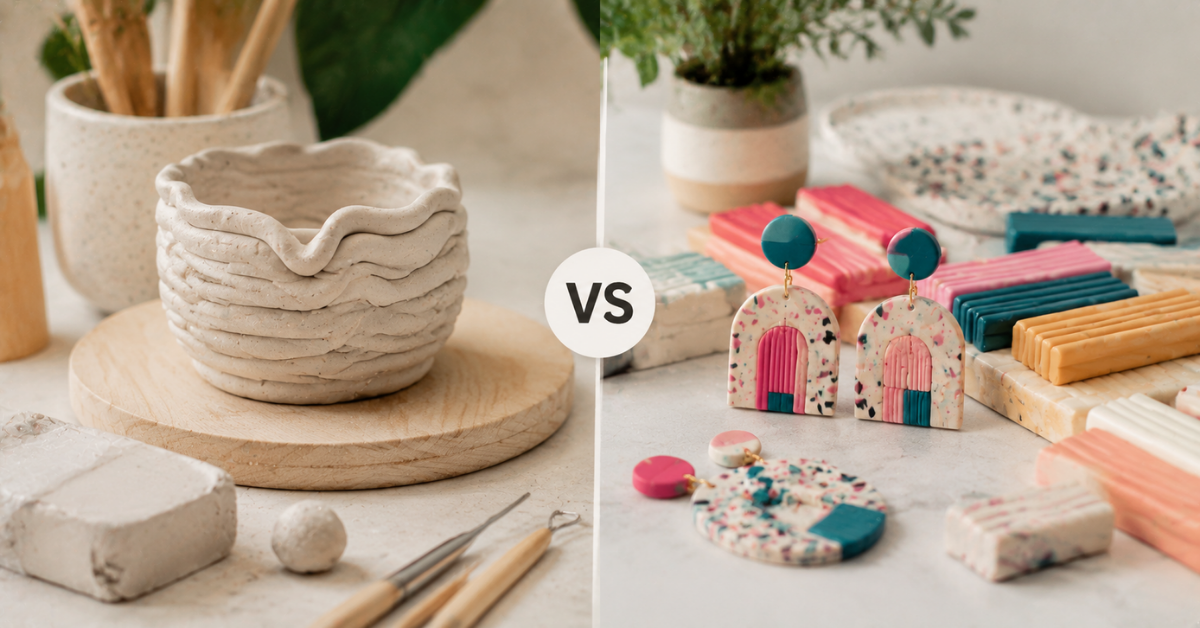
Air-Dry Clay vs Polymer Clay: Which Should You Use?
Choosing between air-dry clay and polymer clay sounds simple until you start planning an actual project. Both can be shaped into figurines, ornaments, accessories, miniatures, and decorative pieces, yet they behave very differently while you work and after they harden. Air-dry clay cures through exposure to air and needs no oven, while polymer clay stays workable until heat is deliberately applied. Those differences affect how much detail you can create, how quickly you need to work, how durable the finished piece will be, and even how you should store your materials.
The choice becomes especially relevant in Singapore. The country has a warm, humid tropical climate with abundant rainfall throughout the year, and environmental conditions can influence how quickly air-dry clay loses moisture. Polymer clay is less dependent on room humidity during curing, but uncured clay still needs protection from excessive heat.
So, air-dry clay vs polymer clay: which should you use? The right answer depends less on which material is “better” and more on what you want to make, how you like to work, and what you expect from the finished object.
Understanding What Makes Air-Dry Clay and Polymer Clay Different
Although both materials are sold as modelling clays, they should not be treated as interchangeable.
Air-Dry Clay Hardens Naturally
Air-dry clay is a broad category of modelling material designed to harden at room temperature without a kiln or household oven. Formulations differ between manufacturers: for example, STAEDTLER describes FIMOair as similar to china clay, while Crayola sells a natural-earth air-dry clay. What these products have in common is that exposure to air causes them to harden as moisture leaves the material.
That makes air-dry clay particularly convenient for home crafting, classrooms, workshops, and larger sculptures that may be inconvenient to fit inside an oven. Depending on the formulation, thickness, temperature, and humidity, drying can take roughly one to three days or longer. Crayola, for example, states that its Air-Dry Clay is typically dry to the touch after about 24 hours and fully dry after about 72 hours, with environmental conditions affecting the timing.
The downside is that drying begins as soon as the material is exposed to air. If you spend a long time adjusting a face, attaching tiny decorations, or reshaping a figurine, the surface may gradually become firmer. Unused clay therefore needs to be kept tightly sealed.
Polymer Clay Hardens Only When You Bake It
Polymer clay behaves almost the opposite way. It is a synthetic modelling material based on polyvinyl chloride, or PVC, and remains workable at room temperature until it is cured using heat. That gives makers considerably more control over when the sculpting stage ends.
This extended working time is one reason polymer clay is popular for detailed figurines, jewellery, miniatures, beads, charms, dolls, and decorative accessories. Firmer polymer-clay formulations are specifically designed to hold fine detail.
Curing instructions depend on the brand, so the package directions always take priority. As one example, STAEDTLER instructs users to preheat an oven to 110°C and harden FIMO for approximately 30 minutes. It also recommends an oven thermometer because actual oven temperatures can differ from the setting.
The Practical Differences That Matter Most
The most useful comparison is not simply “air-dry versus oven-bake.” You need to consider how each material behaves across the full life of your project.
| Factor | Air-Dry Clay | Polymer Clay |
| Hardening method | Dries naturally at room temperature; no oven required. | Remains workable until cured in an oven. |
| Working time | Gradually firms as moisture evaporates. | Can remain workable for extended periods when stored properly. |
| Fine details | Suitable for figurines and decorative sculpture, but very thin elements may become fragile. | Well suited to small details, miniatures, jewellery, and precision work. |
| Dimensional change | Some air-dry clays contract while drying, which can contribute to cracking around rigid supports. | Properly cured polymer clay does not significantly expand or shrink during curing. |
| Water resistance | Generally not waterproof, even after varnishing. | Cured polymer clay can tolerate water better, although care instructions vary by product. |
| Finishing | Can be painted after it has dried completely. | Available in numerous colours and effects and can also be painted or finished after curing. |
| Equipment | Basic modelling tools and a suitable drying area may be enough. | Requires controlled heating according to the manufacturer’s instructions. |
Cracking deserves particular attention with air-dry clay. As moisture leaves the material, the clay contracts. Crayola specifically warns that rigid internal supports can contribute to cracking because the clay shrinks while the armature does not; excessive added water and overly thin sections can also create problems.
Polymer clay avoids that particular drying cycle because it does not air-dry. However, that does not mean it is indestructible. Thin components can still break, and different formulations have different strength characteristics. Correct curing is therefore just as important as careful sculpting.

Which Clay Is Better for Your Project?

Rather than choosing by habit, start with what the finished object needs to do.
- Choose air-dry clay for beginner figurines, decorative sculptures, school activities, casual craft sessions, ornaments, bowls, and larger display pieces when avoiding an oven is important. Its straightforward hardening process makes it especially practical for groups and introductory workshops.
- Choose polymer clay for miniature characters, jewellery, charms, detailed figurines, beads, dolls, and projects with small decorative elements when precision and longer sculpting time matter.
- Choose air-dry clay when painting is part of the experience. White or neutral clay provides an easy base for acrylic, tempera, and other compatible finishes once fully dry.
- Choose polymer clay when colour itself is part of the sculpture. Polymer ranges are available in numerous pre-coloured, translucent, metallic, glitter, and effect formulations, allowing details and patterns to be built directly into the material.
Consider a small cartoon figurine as an example. If your goal is a relaxed weekend activity where you sculpt a character, allow it to dry, and paint the expression later, air-dry clay is a natural fit. If you want a tiny character with crisp fingers, patterned clothing, miniature accessories, and carefully blended colours, polymer clay usually provides more freedom because you decide exactly when the model is ready to harden.
For large decorative pieces, the balance can shift back toward air-dry clay. A large sculpture does not need to fit inside an oven, making natural curing much more convenient.
How Singapore’s Climate and Workshop Setting Affect Your Choice
Singapore’s climate is consistently warm and humid, with typical daytime maximum temperatures around 31–33°C and significant rainfall throughout the year. Because manufacturers state that air-dry clay drying time changes with environmental conditions, it is reasonable to expect drying time in Singapore to be less predictable than a fixed “24-hour” rule, particularly for thick pieces or work kept in humid rooms. That is a practical inference from Singapore’s climate and manufacturers’ drying guidance rather than a universal drying schedule.
Good airflow is therefore useful. Thick objects also need patience: a surface that feels firm does not necessarily mean the centre has dried completely. Painting or sealing too early can interfere with finishing, which is why manufacturers such as Crayola recommend waiting until the piece is fully dry before varnishing.
Polymer clay has a different Singapore-specific consideration: storage. Because excessive heat can begin affecting uncured polymer clay, manufacturers advise keeping it in a cool, dry place away from heaters, hot windows, and direct sunlight. In Singapore, leaving polymer clay beside a sunny window or in a hot enclosed area is therefore a poor storage choice.
For absolute beginners, air-dry clay also reduces the number of variables they must manage at once. There is no curing-temperature calculation during the sculpting session, making it well suited to guided group activities. CraftLabs’ clay figurine workshop in Singapore, for example, introduces participants to handling air-dried clay and modelling tools, giving beginners a structured way to experience clay sculpting before deciding whether they want to explore more specialised materials such as polymer clay later.
That progression makes sense for many hobbyists: first learn how to build forms, join pieces, control proportions, and create expressive details; then choose a more specialised clay when your projects begin demanding greater precision, durability, or longer working sessions.
Want to explore the world of clay sculpting through a hands-on creative experience? CraftLabs workshops provide a guided introduction to clay crafting, where participants learn essential techniques such as shaping, modelling, building forms, and creating their own clay figurines. Whether you are a beginner trying clay for the first time or looking for a relaxing creative activity, CraftLabs offers a structured workshop experience to help you develop confidence and enjoy the process of making handmade pieces. To join a workshop or learn more, visit www.craftlabs.sg or contact CraftLabs for more details.
Frequently Asked Questions
Is air-dry clay or polymer clay better for beginners?
Air-dry clay is usually simpler for a first project because it requires no oven. Polymer clay can also be beginner-friendly, but correct curing temperature and time must be followed.
Which clay is better for detailed figurines?
Polymer clay usually has the advantage for very small or intricate figurines because it does not start drying while you sculpt, and firmer formulations can hold fine details well.
Is air-dry clay waterproof after sealing?
Generally, no. Crayola states that acrylic varnish can seal its Air-Dry Clay but does not make the material waterproof, so finished pieces are best kept indoors and away from prolonged water exposure.
Do you need a special oven for polymer clay?
Many polymer clays are designed for curing in a household oven, but you must follow the specific manufacturer’s temperature and timing instructions. An oven thermometer is recommended for better temperature control.
