

Is Melt-and-Pour Soap Safe for Kids?
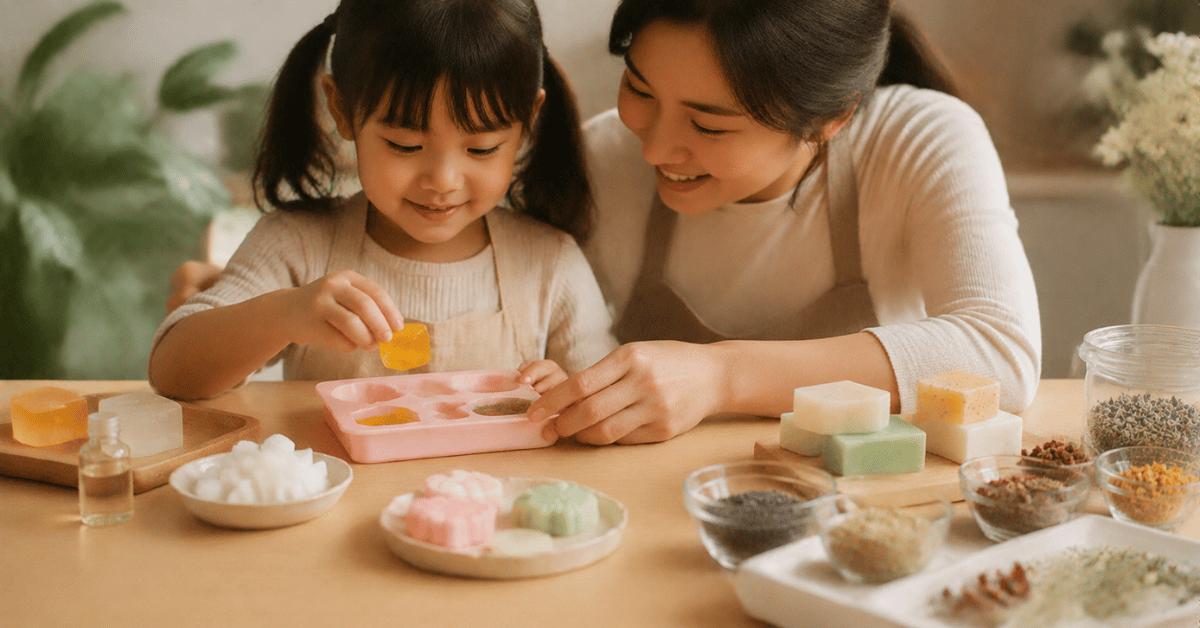
Soap making looks like an ideal children’s activity: it is colorful, creative, hands-on, and children leave with something they can actually use. But the moment parents hear words such as “heated soap,” “essential oils,” “colorants,” and “cutters,” a reasonable question follows: Is melt-and-pour soap actually safe for kids?
For most children, the answer is yes—melt-and-pour soap making can be a child-friendly craft when suitable ingredients are used and adults control the hot and sharp parts of the process. It is particularly well suited to beginner workshops because children work with an already-manufactured soap base rather than preparing soap from raw oils and caustic alkali themselves. Commercial melt-and-pour bases are designed to be cut, melted, customized, poured into molds, and allowed to harden.
That does not make the activity risk-free. The important distinction is between the soap itself and the soap-making process. Finished soap may be perfectly appropriate for a child’s skin while melted soap, cutting equipment, concentrated fragrances, or essential oils still require sensible precautions.
For parents considering a kids’ soap-making activity in Singapore, here is what actually matters.
The Real Safety Risks Parents Should Pay Attention To
Heat and Cutting Tools Need Adult Control
The most obvious hazard comes before the soap reaches anyone’s skin.
Melt-and-pour base has to become hot enough to liquefy. Different formulations have different processing temperatures; commercial bases commonly begin softening or melting around temperatures that are easily capable of causing a burn. That means a container of melted soap should be treated in much the same way as another hot craft material—not as something harmless simply because it is “soap.”
Singapore’s HealthHub advises parents to protect children from hot liquids because they can cause scald injuries, and its burn guidance recommends immediately cooling a burn under cool running water for 20 minutes rather than applying ice.
Cutting is another overlooked part of melt-and-pour soap making. Soap bases are normally divided into smaller pieces before heating. Stephenson recommends knives or soap cutters for slicing its melt-and-pour bases.
Craft Labs addresses this specifically: although its Singapore soap workshop welcomes participants across age groups, it encourages adult supervision for children below 12 because a knife or cutter is used to prepare the base. Trainers and facilitators are also present to provide assistance.
In practice, younger children do not need to perform every step themselves to enjoy the activity. An adult can cut the base and manage the hottest container while the child chooses colors, mixes a cooled preparation when instructed, arranges decorative layers, and helps with molds.
Skin Reactions and Accidental Ingestion Matter Too
The second issue is not the soap-making technique but what gets added to the soap.
Colorants, fragrances and essential oils can make handmade soap more appealing, but “natural” does not automatically mean suitable for every child. Singapore’s Health Sciences Authority notes that skin sensitivity and allergic reactions are among the common problems associated with cosmetics and that natural or herbal ingredients are not necessarily safer simply because of their origin.
This is especially relevant to children who already experience eczema or sensitive skin. KK Women’s and Children’s Hospital recommends avoiding strong soaps and chemicals for children with atopic dermatitis and advises fragrance-free skin care where appropriate. HealthHub similarly advises people with eczema to avoid shower products containing fragrances and colorings when these trigger irritation or allergic reactions.
Essential oils deserve additional care because the concentrated oil in the workshop bottle is very different from the small amount that may eventually be dispersed through a finished soap. Singapore HealthHub specifically identifies essential oils among substances that can be harmful when accidentally swallowed by young children.
The practical lesson is simple: adults should handle concentrated additives, follow the recommended quantity rather than adding extra scent for a stronger smell, and keep bottles away from young children.
How to Choose Kid-Friendly Soap Ingredients
The phrase “melt-and-pour” describes a method, not one universal formula. Two soap bases can contain different surfactants, oils, fragrances, preservatives, or other ingredients. Some manufacturers even offer multiple versions, including transparent, white, sulfate-free, botanical, milk-containing, and soap-free melt-and-pour bases.
For children, especially those with known skin sensitivities, a simpler formulation is usually easier to assess. Parents or workshop organizers should consider:
- The soap base: Use a clearly labeled cosmetic-grade melt-and-pour base from a reputable supplier rather than an unidentified craft material.
- Fragrance: A fragrance-free version is the simplest choice for a child with eczema, fragrance sensitivity, or a history of reactions.
- Essential oils: Treat them as concentrated ingredients, use only the intended quantity, and make them optional rather than essential to the activity.
- Colorants: Choose colorants specifically intended for cosmetic or soap use rather than food coloring, art paint, or unidentified pigments.
- Known allergies: Review the ingredient list when a base contains additions such as goat’s milk, plant extracts, or specialty oils.
There is also an important Singapore-specific point. Cosmetic products supplied locally fall under Singapore’s Health Products legislation and the ASEAN Cosmetic Directive, which specifies prohibited and restricted substances as well as permitted colorants and preservatives.
Parents therefore should not rely solely on broad marketing phrases such as “natural,” “hypoallergenic,” or even an overseas approval claim. HSA explicitly explains that cosmetic notification in Singapore is not an HSA endorsement, and suppliers remain responsible for ensuring ingredient and labeling compliance.
For a child with particularly reactive skin, HSA recommends trying a cosmetic on a small area first and stopping its use if irritation occurs. Products also should not be applied to already irritated or damaged skin.

A Practical Safety Checklist for Kids’ Soap-Making Workshops
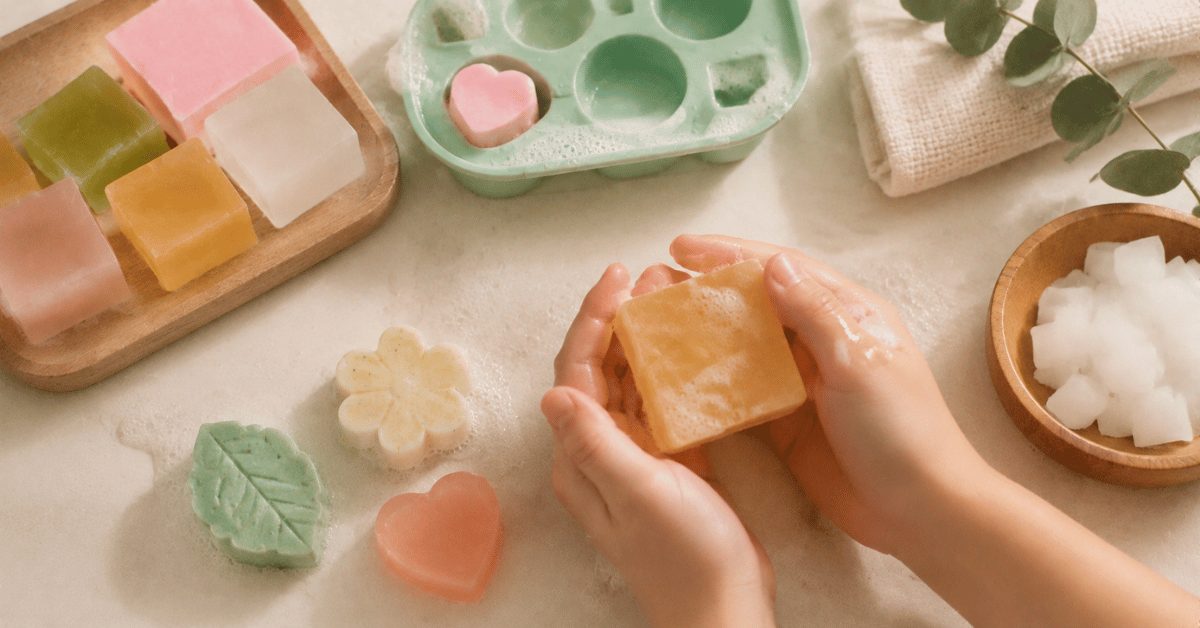
A good children’s workshop does not need to remove every interesting step. It needs to assign each step to the right person.
For a safer soap-making workshop in Singapore, parents and organizers can follow a straightforward approach:
- Let an adult or instructor handle knives, soap cutters, microwave ovens, heating equipment, and containers of freshly melted soap.
- Keep the work area stable and uncluttered so children cannot accidentally knock over hot containers.
- Use only measured quantities of fragrance or essential oil rather than allowing children to pour directly from concentrated bottles.
- Keep soap materials away from the mouth and eyes, and make handwashing part of the activity.
- Check beforehand whether a child has eczema, known fragrance sensitivities, allergies, or an active skin rash.
- Choose an unscented or minimally customized bar when skin sensitivity is a concern.
- Follow the soap-base manufacturer’s processing instructions instead of overheating the material.
- Allow finished bars to cool and solidify completely before children handle or pack them.
The Bottom Line: Melt-and-Pour Soap Can Be Safe for Kids With the Right Setup
So, is melt-and-pour soap safe for kids? Generally, yes—but its safety depends on both the ingredients and how the activity is managed.
Its biggest advantage for children is that they can experience soap making without personally measuring and mixing the raw caustic ingredients used to manufacture soap from scratch. That makes melt-and-pour particularly practical for workshops, family activities, school programs, and beginner crafts.
The remaining risks are manageable rather than mysterious: melted soap can burn, cutters can injure, concentrated essential oils should not be treated like toys, and fragrances or other ingredients can irritate sensitive skin. Singapore health guidance also makes clear that cosmetic ingredients are not universally suitable for everyone simply because they are described as natural.
A well-run children’s soap activity therefore puts creativity in the child’s hands while keeping heat, sharp tools, ingredient dosing, and safety decisions in adult hands.
That balance is what turns melt-and-pour soap making from merely an attractive craft into a genuinely suitable learning experience for children.
Looking for a safe and creative soap-making experience for kids? CraftLabs workshops provide a guided hands-on activity where participants learn how to create personalized soaps while understanding the basics of ingredients, designs, and safe crafting practices. With expert guidance and proper supervision, children can enjoy the fun of soap making while developing creativity and confidence through a practical workshop experience. To join a CraftLabs workshop or learn more, visit www.craftlabs.sg or contact CraftLabs for more details.
FAQs
Is melt-and-pour soap safer for children than cold-process soap making?
For the making activity, generally yes. The melt-and-pour base has already been manufactured, so children do not need to measure or mix raw caustic alkali during the workshop. Heat and cutting tools still require supervision.
Can children use the soap they make afterward?
Yes, provided the base and additives are intended for cosmetic use and the child does not react to the ingredients. Children with eczema or sensitive skin may be better suited to a mild, fragrance-free option.
Are essential oils necessary in kids’ soap?
No. Essential oils mainly provide scent or other formulation characteristics and can be left out. Craft Labs, for example, makes their use optional in its gemstone soap workshop.
What age can children start melt-and-pour soap making?
There is no single age that makes every step automatically safe. Supervision and the child’s ability to follow instructions matter. Craft Labs welcomes different age groups but recommends adult supervision for children under 12 because cutters are involved.
